 Phone orders on 0208 088 2269/ £14.99 delivery for all orders
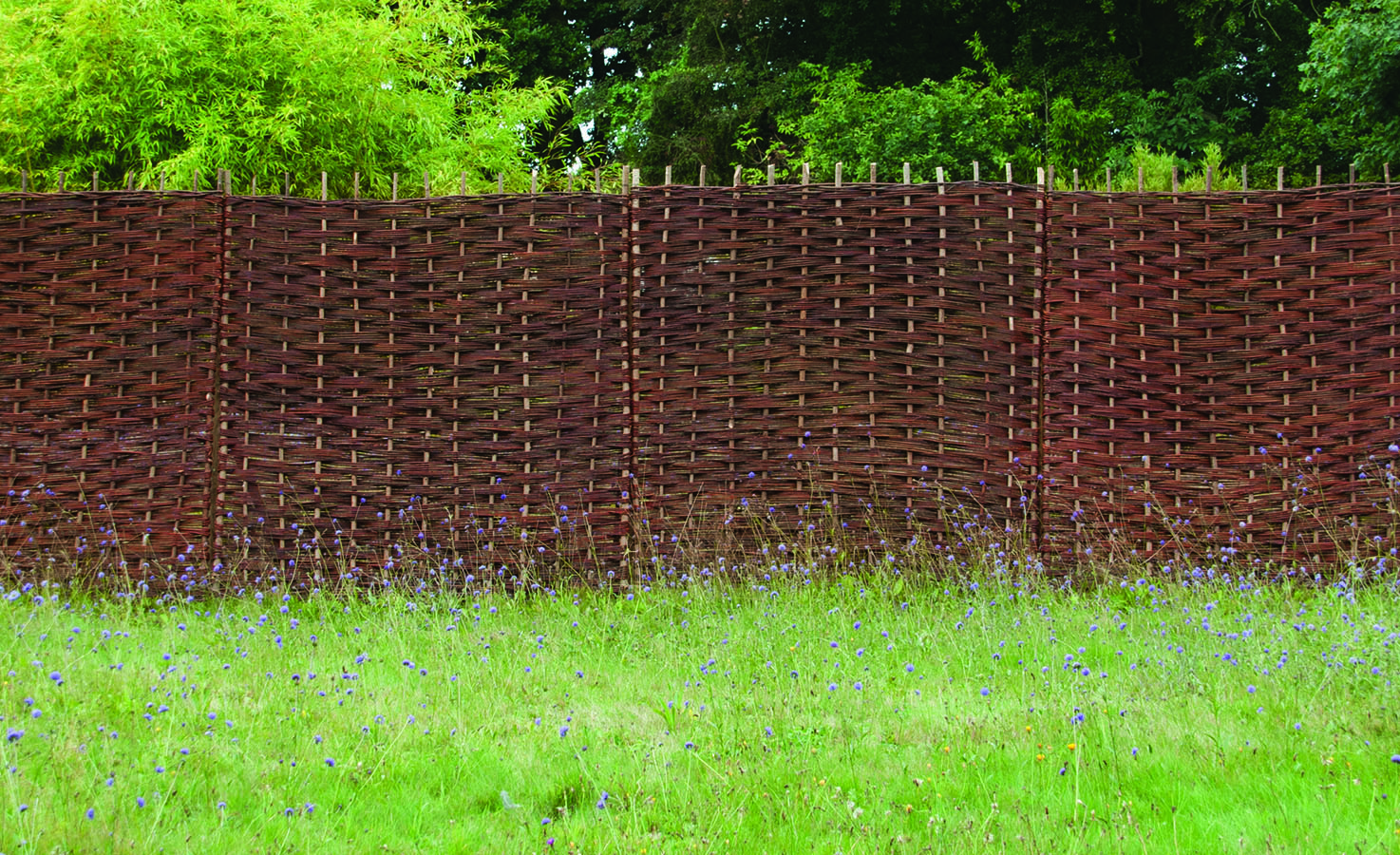
It is the question we are asked more than any other, and the honest answer is that neither is better. Hazel and willow are cut from coppiced British woodland, woven by the same hands using the same method, and last about as long as each other. They even cost within a pound or two per panel. What separates them is colour and character — and once you have seen the two together, the choice usually makes itself.
The difference you will actually notice
Stand in front of both and you will not be thinking about durability or price. You will be looking at the colour, because it is not a subtle distinction.
Willow
A deep, warm red-brown — russet through to oxblood depending on the light and the time of year. The rods are slim and the weave is close and even, so the panel reads as a finished, almost furniture-like surface.
Willow brings colour into a garden. It sits beautifully against green planting, red brick and pale stone, and it lifts a shaded corner in a way that grey timber never manages.
Hazel
A soft silver-grey with olive and honey running through it. The rods are thicker and the weave looser and more openly rustic, so you read the individual rods rather than the panel as a whole.
Hazel recedes. It is the natural choice for cottage gardens, older houses, working plots and anywhere you want the boundary to disappear rather than announce itself.
Put at its simplest: choose willow if you want the fence to add something, and hazel if you want it to step back. Plenty of gardens use both — willow where it will be seen and hazel where it merely needs to do a job.
The weave, and why it matters more than you would think
The colour is what you notice first, but the weave is what you live with.
Willow rods are slender, which means more of them go into the same panel and they sit tighter together. The result is a denser surface — better at breaking a view, better at blunting wind, and neater at close quarters. If a panel is going somewhere people stand within a few feet of it, a patio screen or a seating area, willow tends to look more considered.
Hazel rods are thicker and the weave is deliberately looser. You see gaps. That is not a fault — it is the character of the thing, and it is why hazel looks right against an old brick wall or a gravel path in a way that a tighter weave can look almost too tidy. It does mean a hazel panel screens slightly less than willow at the same height.
What those thicker rods buy you is substance. Hazel is the more robust of the two — heavier in the hand, better at shrugging off a knock, and the reason it was the traditional choice for penning livestock long before anyone bought one for the look of it. Willow is the more refined panel; hazel is the tougher one.
Worth knowing: each has one practical edge. Willow’s closer weave gives marginally more privacy at the same height. Hazel’s thicker rods make the sturdier panel where it will take wear. Choose on whichever matters more where the fence is going.
Price will not decide this for you
People often assume one must be the cheap option. They are within a couple of pounds of each other at every height, and which is cheaper actually swaps around as you go up:
| Height | Hazel | Willow | Difference |
|---|---|---|---|
| 1ft × 6ft | £27.49 | £28.99 | Hazel cheaper by £1.50 |
| 2ft × 6ft | £31.76 | £29.79 | Willow cheaper by £1.97 |
| 3ft × 6ft | £32.25 | £30.30 | Willow cheaper by £1.95 |
| 4ft × 6ft | £38.37 | £36.65 | Willow cheaper by £1.72 |
| 5ft × 6ft | £45.90 | £46.41 | Hazel cheaper by £0.51 |
| 6ft × 6ft | £53.92 | £54.16 | Hazel cheaper by £0.24 |
Across a ten-panel run the difference is under twenty pounds either way. Delivery is £14.99 flat on both, whatever the size of the order. So put price aside and choose on looks — you will be looking at this fence for years, and you will have forgotten the two pounds by the time it is up.
Do they last the same?
Yes. Expect five to ten years from either in an ordinary British garden, and the things that decide where you land in that range are the same for both.
What shortens a woven panel’s life is standing water and movement — not the species. A panel sitting in wet soil against a north-facing wall will go long before one with an inch of clearance underneath and air on both sides. A panel fixed at two points per upright will work itself loose over a couple of winters; one fixed at four points will not.
We go into this properly in our guide to how long hazel hurdles last — every word of it applies to willow too.
Which one suits your garden?
After enough of these conversations, some clear patterns emerge.
Willow tends to be right for: contemporary planting schemes, courtyard and city gardens, screening a patio or hot tub, anywhere against red brick, and anywhere the fence will be looked at rather than looked past. Also the better choice if maximum privacy at a given height is the priority.
Hazel tends to be right for: cottage and country gardens, period properties, allotments and kitchen gardens, livestock and estate work, gravel and stone, and anywhere you want the boundary to vanish into the background. It is also the one to pick where the fence will take real wear — the thicker rods make it the more robust panel.
If you are still undecided, there is a simple test. Look at what the fence will sit against. Green planting and brick flatter willow’s warmth; grey stone, old timber and pale render flatter hazel’s silver. The material that agrees with its background is nearly always the right answer.
Can you mix them?
You can, and it works better than people expect — but with one rule: split them by area, not by panel. Alternating hazel and willow along a single run looks like a mistake. Willow around the terrace and hazel down the side return looks like a decision.
Fitting them is identical
Whichever you choose, the job is the same. Both are fixed to the face of a post rather than slotted into it, which is why a run can follow a curve or a slope without a saw coming out.
Use our 1.8m UC4 posts for panels up to 4ft and the 2.4m posts for 5ft and 6ft, one at each end and one at every 6ft join — so a four-panel run needs five posts. Allow around 60cm in the ground, and concrete them on soft, exposed or coastal sites.
Then fix each panel with four stainless steel cable ties per upright, eight per 6ft × 6ft panel, threaded through the weave and drawn tight against the post. Not galvanised wire, which hardens where you twist it and eventually snaps. Not screws, which split the uprights. Ties come fifty to a pack, enough for six full-height panels.
The whole sequence is photographed in our hurdle fitting guide.
Common questions
Is hazel stronger than willow?
Yes. Hazel rods are noticeably thicker, and the panel is more robust with it — it takes knocks, leaning and general wear better, which is why hazel has always been the material for livestock work and hard-used boundaries. Willow is the finer of the two: slimmer rods, a tighter weave, a more refined finish. Neither is fragile, but if the fence is going somewhere it will get bumped or worked around, hazel is the sturdier choice.
Which is better for privacy?
Willow, marginally, because the closer weave leaves fewer gaps. But height matters far more than material: a 6ft hazel panel screens vastly better than a 4ft willow one. Choose the height first, then the material.
Does willow fade to grey like hazel?
Both weather, but they do not converge. Willow softens from its initial red-brown towards a warmer, dustier tone while keeping the warmth. Hazel silvers further. A willow fence at five years still reads as warm; a hazel fence reads as grey.
Which is more eco-friendly?
Equally so. Both are coppiced, which means the stool is cut on rotation and regrows — the woodland is not felled, it is managed, and coppicing actively supports woodland biodiversity. Neither is treated with anything, and at end of life both simply compost.
Can I use hazel and willow in the same garden?
Yes, provided you separate them by area rather than alternating panels along one run. See above.
Still not sure?
Browse both and see them side by side — hazel hurdles and willow hurdles are available in all six heights from 1ft to 6ft, every panel 6ft wide and handwoven from British coppiced wood. If you would like help choosing, get in touch and tell us what the fence needs to do — we would rather talk it through than have you order the wrong thing.
For the wider picture — what hurdle fencing is, what a run costs and how to put it up — see our guide to hurdle fencing.
If you arrived here searching for something other than “hurdles” — woven fence panels, wicker or wattle — that guide explains the names and how they compare with lap and close board. And if privacy is the actual aim, garden screening works backwards from what you are trying to hide.