 Phone orders on 0208 088 2269/ £14.99 delivery for all orders
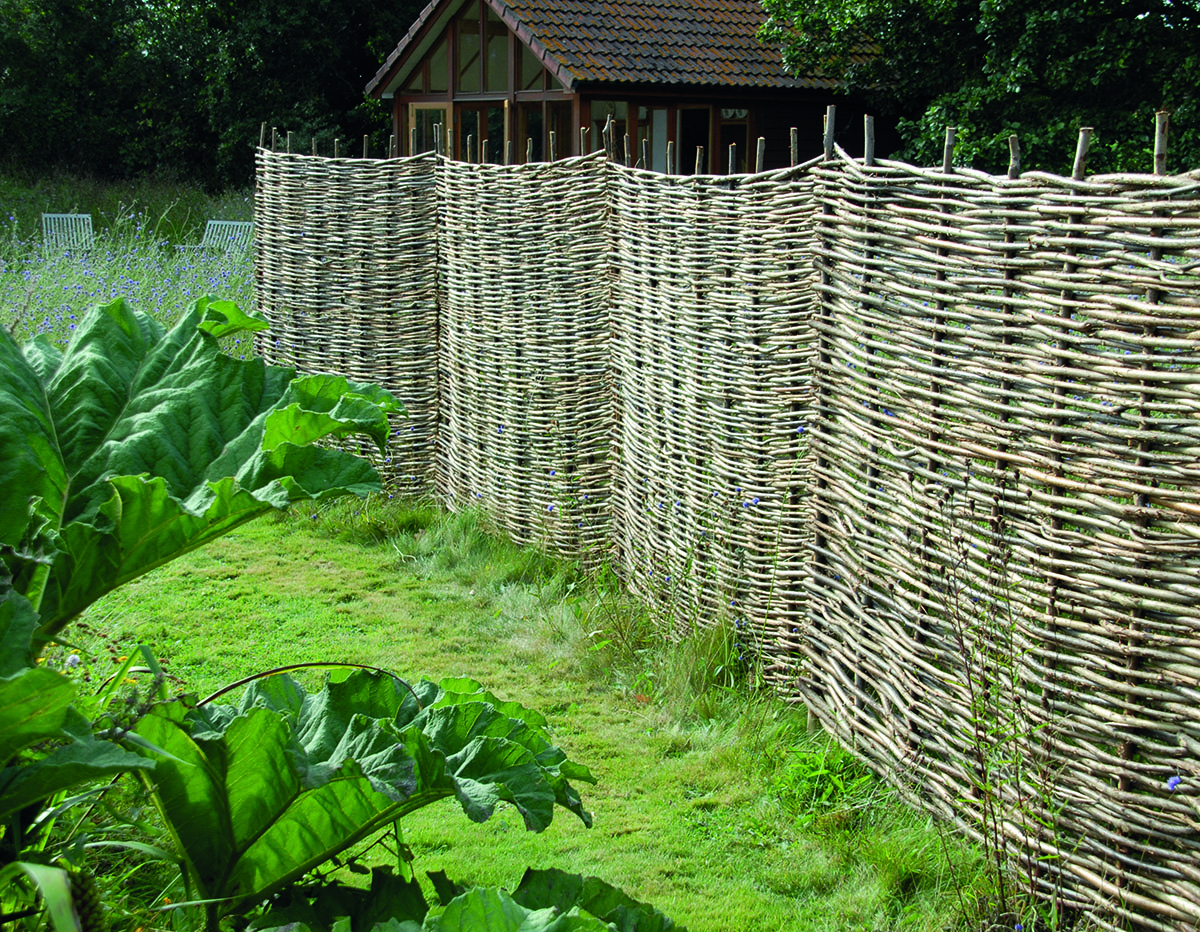
A hazel hurdle lasts five to ten years in an ordinary British garden. It is a range rather than a single number because two panels out of the same bundle, woven the same morning by the same pair of hands, can end up five years apart depending only on where they are put.
One goes onto a free-standing post line with daylight underneath it and air on both faces, and it is still tight at year ten. The other gets fixed flat against a damp north wall with its bottom uprights sitting in the soil, and it is going soft by year five. Nothing about the panel decided that. The garden did.
So the useful version of this article is not the number. It is which of those two gardens yours is, and what to change if it is the second one.
Why is the range so wide?
Because hazel goes up as untreated green wood and survives by drying out between downpours, so anything that stops it drying costs you years. Rain is not the enemy — a hurdle is rained on several hundred times a year and shrugs it off. Damp that has nowhere to go is the enemy.
That means three site conditions do almost all the work: how well the ground drains, whether air can move across both faces, and whether the base of the panel is touching soil. Get those three right and you are at the top end. Get them wrong and no amount of oil, and no amount of paying more for the panel, will buy the years back.
What shortens the life of a hazel hurdle?
Standing water at the base, more than anything else. A panel whose bottom uprights sit in a puddle after every shower is wicking water upwards into the weave for days at a time, and that is where the softness always starts.
After that, in rough order of how much damage they do:
- No air on one side. A hurdle pressed flat to a wall, a solid fence or a dense hedge can only dry from one face. Same with ivy or a vigorous climber let loose over it — the weave underneath stays wet for weeks and goes from the inside out, where you cannot see it happening.
- Movement. A working weave holds its shape through tension, and a panel tied at only two points per upright rocks in every gust. Rocking chafes the rods where they cross, and once the weave loosens it starts shaking itself apart. This is the failure we see most often on panels that had years left in them.
- A north-facing damp corner. The spot that never quite dries out in winter. It is not fatal, but expect the lower end of the range there and check the base each spring.
- Ground contact. Soil banked up against the bottom, or a bed built up in front of the panel after it went in, puts permanently wet earth against permanently untreated wood.
- A post that rocks. If the post moves, the panel moves. More on that below, because it is the failure people never see coming.
How do you make hazel hurdles last longer?
Five things, and between them they are worth more than any product you can buy for the job:
1. Lift the panel an inch or two off the ground. Prop it on offcuts while you tie it, so the bottom uprights end up with a gap of daylight underneath. This single act buys more years than everything else on this list combined, and it costs nothing.
2. Use four fixings per upright, not two. Four points stop the panel working against itself in wind. Two points give it a hinge.
3. Check the ties once a year. Hazel shrinks as it seasons, so a tie that was tight in March may have a little slack in it by the following March. Five minutes with a hand on each panel tells you everything.
4. Leave both faces open to moving air. If you must run a hurdle along a wall, hold it off with a batten so there is a gap behind, and keep climbers thinned rather than smothering.
5. Set the posts properly. A solid post that does not shift is part of the panel’s lifespan, not a separate job.
Do all five and ten years is a realistic expectation rather than an optimistic one.
Do hazel hurdles rot?
Eventually, yes — hazel is untreated natural wood and it is supposed to return to the soil in the end. What matters is that rot in a hurdle is almost always local rather than general. It begins at the bottom couple of inches of the uprights, where wood meets ground, and works upwards slowly.
That is why clearance matters so much, and it is also why a hurdle rarely fails all at once. You will usually notice one or two uprights going punky at the base a good year before the panel stops doing its job, which gives you plenty of warning to plan a replacement rather than discover one after a gale.
How does hazel change as it ages?
It pales. Hazel starts as a soft silvery grey-brown with olive and honey underneath it, and over four or five seasons of sun and rain the warmer notes fade and it settles into a quieter, paler grey. The texture stays exactly as it was; only the colour moves.
Most people find this is the point at which the fence looks its best — a run of grey hazel behind planting reads as background rather than as a fence, which is precisely what it was cut to do. It is worth knowing in advance, though, because the panel you unwrap and the panel you have in year four are noticeably different in tone. If you want to hold the colour longer, see treatment below.
Willow behaves differently and is often confused with hazel here. Willow is a deep red-brown, russet through to oxblood, finer in the rod and closer in the weave; it keeps that warmth rather than going grey. Hazel is the silver-grey one, thicker rods, looser and more rustic. If a supplier’s photographs make hazel look red-brown, you are looking at willow.
How should you treat hazel hurdles?
Most people treat them with nothing at all, and that is a perfectly sound decision — an untreated panel kept dry at the base will still reach the top of the range. Treatment is about appearance far more than longevity.
If you would rather slow the fade to grey, a clear breathable oil brushed on in late summer, when the rods are dry, is all that is needed, repeated every couple of years. What you must never use is varnish or any film-forming sealer. It seals damp into the rods instead of keeping it out, and a panel that cannot breathe fails faster than one you left alone. We go through the products and the timing in our guide to hazel hurdle treatment.
When is hazel cut for hurdles, and does it matter?
Hazel is coppiced between November and March, with the sap down, and it matters a great deal. Winter-cut rods rive cleanly along the grain rather than tearing, and clean-riven wood sheds water instead of holding it in torn fibres.
The rods are then split and woven green around upright sails, so that as the panel dries it tightens onto itself. Nothing is nailed, glued or stapled anywhere in a hurdle — the tension in the weave is the entire structure. That is the reason movement is so damaging, and the reason the fixing method below is not a detail. Coppice regrows from the same stool for generations, which is also why this is one of the few genuinely renewable fencing materials in the country. There is more of the craft background in our 40 things worth knowing about hazel hurdles.
Do the posts and fixings affect how long the panel lasts?
More than the panel itself does, in the end — a post that fails takes a perfectly good hurdle down with it, and rot in a post starts underground where nobody looks.
Use pointed machine round fence posts pressure treated to UC4. That use class is specified for permanent ground contact, and it is a deeper, more thorough treatment than the general green preservative used on rails, gravel boards and decking timber. A 1.8m × 100mm post carries panels up to 4ft; go to 2.4m × 100mm for 5ft and 6ft. Drive them into firm ground, and on sand, wet clay or an exposed coastal site concrete them and let them cure before you hang anything.
Fix each hurdle with stainless steel cable ties — four to every upright, so eight on a 6ft × 6ft panel, threaded through the weave and drawn tight around the post. They come fifty in a pack, which is enough for six panels at full height. Not galvanised wire, which work-hardens at the twist and snaps in a season or two, and not screws, which split the uprights and pin the panel so it has nowhere to give when wind gets under it. Stainless holds fast and still allows the millimetre of movement a woven panel needs. The whole sequence is photographed step by step in our installation guide.
Is five to ten years good, compared with other fencing?
It is shorter than a pressure-treated close-board fence, and there is no point pretending otherwise. A close-board run will give you fifteen years or more.
Here is the exchange you are making. A hurdle costs a good deal less up front — hazel panels start at £27.49, and a full-height 6ft × 6ft panel is £53.92, with £14.99 flat delivery anywhere on the UK mainland whether you order one or twenty. It filters wind rather than fighting it, so it rides out the gales that lay close-board panels flat across a garden, and the planting behind it gets shelter instead of a hard downdraught. It has no bad side, so there is nothing to negotiate with a neighbour about. It looks better every year it stands rather than worse. And it is FSC-certified coppice product that grows back, not sawn plantation timber.
Set against a fence that costs two or three times as much and needs a treatment every few years to reach its longer life, five to ten years of hurdle looks a good deal more even than the raw numbers suggest.
When should you replace one?
When several uprights have gone soft at the base and the weave has slackened enough that you can push the middle of the panel more than an inch or so. Replace individual panels as they go rather than the whole run — one of the quiet advantages of hurdles is that a run is made of separate units, so a single failure is a single replacement, cut the ties and lift the new one on.
Browse the full range of hazel hurdles in six heights, from 1ft × 6ft edging up to full-height boundary panels — all 1.83m (6ft) wide, all handwoven, and all good for five to ten years if you keep their feet dry.
Common questions
How long do hazel hurdles last?
Five to ten years in an ordinary British garden. Where a panel lands in that range depends on drainage, airflow and ground clearance rather than on the panel itself. Kept clear of wet soil with air on both faces, ten years is realistic.
Do hazel hurdles rot?
Eventually, yes — hazel is untreated natural wood. Rot begins at the bottom inch or two of the uprights where wood meets soil, and travels upwards slowly. An inch of clearance under the panel delays it by years.
How do you make a hazel fence last longer?
Lift it an inch or two off the ground, fix it with four stainless cable ties per upright instead of two, keep air moving on both faces, and check the ties once a year. Set the posts firm.
Do you need to treat hazel hurdles?
No. Most are left untreated and weather to a paler grey. A clear breathable oil in late summer slows the fade if you prefer the original colour. Never use varnish — it traps damp inside the rods.
Which lasts longer, hazel or willow hurdles?
Neither. Both come from coppice, both are woven by hand, both fix to posts the same way, and both give five to ten years. Choose on looks: hazel is silver-grey with a looser rustic weave, willow a deep red-brown with a closer one.
Choosing rather than maintaining? Woven fence panels covers how these compare with other panel types, and garden screening helps pick the right height for the job.