 Phone orders on 0208 088 2269/ £14.99 delivery for all orders
Willow Hurdles
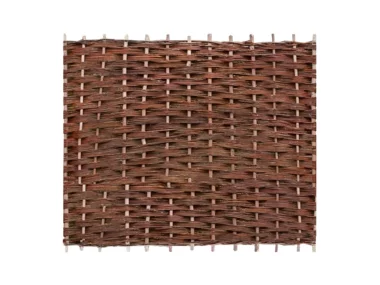
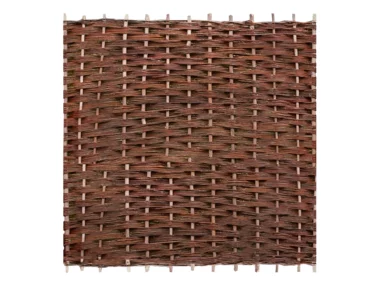
There is a moment, an hour or so after the sun comes round, when a willow hurdle stops looking like a fence. The light finds the weave, the rods deepen from russet to something close to oxblood, and what you have is less a boundary than a backdrop.
That is the difference willow makes. Where hazel is silvery and understated, willow is a deep, warm red-brown — a richer colour, a tighter weave, and a surface that gives a garden real warmth rather than simply dividing it.
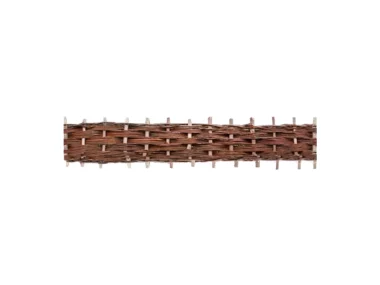
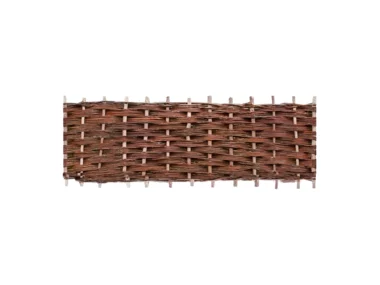
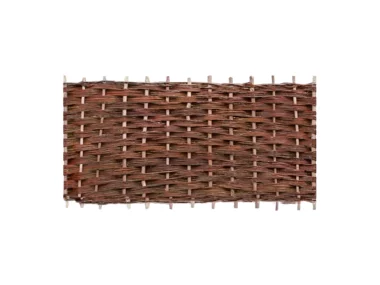
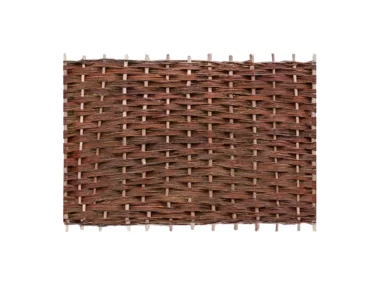
Every panel here is handwoven from coppiced willow. No two are identical, because no two rods grow the same. They arrive ready to fit, in six heights, all a standard 6ft wide.
Showing all 6 results
Choosing your height
| Height | Best for | Price |
|---|---|---|
| 1ft × 6ft | Edging beds, borders and paths | £28.99 |
| 2ft × 6ft | Low definition between planting areas | £29.79 |
| 3ft × 6ft | Boundaries you want to see over | £30.30 |
| 4ft × 6ft | Screening patios and seating areas | £36.65 |
| 5ft × 6ft | Privacy without enclosing a garden | £46.41 |
| 6ft × 6ft | Full-height boundary screening — made to order | £54.16 |
Not sure? The rule most of our customers arrive at: 4ft if you want to soften a view, 5ft or 6ft if you want to stop one. Below 3ft is decorative — beautiful, but it will not hide anything.
Willow or hazel?
Both are woven by hand, both are coppiced, both last well. The real difference is colour, and it is not a small one.
Willow
A deep, warm red-brown — russet through to oxblood depending on the light. The rods are slim and the weave is close and even. Willow brings colour and warmth to a garden, and it looks especially good against green planting, brick and stone.
Hazel
A soft silver-grey with olive and honey in it. Thicker rods, a looser and more rustic weave. Hazel recedes rather than announces — the natural choice for cottage gardens, older houses and working plots.
Put simply: choose willow if you want the fence to add colour, and hazel if you want it to disappear. Neither is the better product — they are different characters, and plenty of gardens use both.
We compare the two properly — colour, weave, privacy, price and lifespan — in our guide to choosing between hazel and willow.
Fitting them
Willow hurdles are fixed to posts rather than slotted into them. We supply pointed machine round fence posts in 1.8m and 2.4m, UC4 pressure-treated for ground contact. Use the 1.8m post for panels up to 4ft and the 2.4m post for 5ft and 6ft.
Set one post at each end of the run and one at every 6ft join, so a four-panel run needs five posts. Drive them in on firm ground; concrete them on soft, exposed or coastal sites.
Then fix each hurdle with stainless steel cable ties — four to each upright, so eight per 6ft × 6ft panel, threaded through the weave and pulled tight against the post. Ties come fifty to a pack, enough for six full-height panels. Cable ties are the right fixing here: galvanised wire kinks and eventually rusts through, and screws split the uprights and leave the panel nowhere to move when the wind gets underneath it.
Step-by-step photographs are in our hurdle fitting guide.
How long do willow hurdles last?
Expect five to ten years in an ordinary British garden. The range is wide because the variables are. A panel kept clear of wet ground, given air on both sides and fixed properly to a solid post will reach the top of that. One sitting in a puddle against a north wall will not.
Three things extend the life of a woven panel more than anything else.
- Keep the bottom of the panel off the soil. An inch or two of clearance is worth more than any treatment.
- Fix at four points per upright, not two. Movement is what breaks a weave.
- Check the ties once a year. A two-minute job in spring stops a panel working itself loose over winter.
For more on care and weathering, see our guide to treating and maintaining hurdles.
Delivery
£14.99 on every order, whatever the size. We deliver across the UK mainland and pack panels so they arrive as they left — handwoven work does not survive being thrown about.
New to these? Our guides explain hurdle fencing from the ground up, what people mean by woven fence panels, and how to work out the right height for garden screening.
You may also see these sold as wicker fence panels or wattle — same product, older names. We explain which is which there.