 Phone orders on 0208 088 2269/ £14.99 delivery for all orders
Almost every fence question that turns into an argument comes down to three things: how high you are allowed to build, whose fence it actually is, and which way round it has to face. None of it is as complicated as it feels, and one of the three stops being a problem entirely if you use hurdles. Here is the plain version.
How high can a garden fence be?
In England and Wales the general rule under permitted development is 2 metres — roughly 6ft 7in — for a fence, wall or gate. Build to that and you do not normally need planning permission.
There is one common exception that catches people out. Where the boundary adjoins a highway used by vehicles, or a footpath running alongside one, the limit drops to 1 metre. That is the front garden rule, and it is why front boundaries are so much lower than back ones.
| Where | Usual limit | Our tallest panel |
|---|---|---|
| Rear and side boundaries | 2m (about 6ft 7in) | 6ft — inside it |
| Front, adjoining a road | 1m (about 3ft 3in) | 3ft — inside it |
| Front, no road adjoining | 2m | 6ft — inside it |
So a 7ft fence does need planning permission in almost every ordinary garden. Everything we make stops at 6ft, which sits comfortably under the limit.
The height includes everything on top. Trellis, a lattice topper, decorative finials — the fence is measured as one structure. A 6ft fence with a 1ft trellis above it is a 7ft fence as far as the rules are concerned.
Posts standing proud of the panel count too. If you are close to the limit, cut them level. And if the ground is higher on one side than the other, how the height is measured depends on the site — if you are building near 2m on a slope, ask your council before you start rather than after.
Three things override all of the above, so check before you build: listed buildings, conservation areas and Article 4 directions can all remove permitted development rights. So can a covenant in your deeds, which is common on newer estates and has nothing to do with planning at all — it is a private restriction and the council will not know about it.
Scotland and Northern Ireland work to their own rules. If you are outside England and Wales, treat the figures above as a guide and check locally.
Whose fence is it?
This is the one that causes most of the bad feeling, usually because of a myth.
There is no rule that you own the fence on the left, or the right. None. It is repeated constantly and it is simply not true. Ownership is whatever your title deeds say, and often they say nothing at all.
If the deeds do settle it, they usually do so with T marks on the plan: a small T drawn against the boundary, with the crossbar on the side of whoever is responsible for it. A T on your side means it is yours to maintain. An H mark — two Ts back to back — means the boundary is shared.
If there are no marks and no wording, nobody owns it definitively, and the practical answer is that whoever wants a fence builds one. You are also entitled to build your own fence just inside your boundary, alongside an existing one, without anyone’s permission.
What you cannot do is alter, paint, lean things against or attach anything to a fence that belongs to your neighbour — not even on your side. It is their property. Ask, and most people say yes; do it without asking and you are in the wrong however reasonable it seemed.
Equally, you are under no legal obligation to have a fence at all in most gardens, and none to replace one that has fallen down, unless a covenant or a specific deed clause says otherwise.
Do you have to give your neighbour the good side?
No. There is no law about it. The convention is that the smooth face goes outward and the posts and rails face in — partly good manners, partly because it is easier to maintain a fence you can reach the fixings of.
But it is a convention, not a rule, and it is the source of an enormous amount of low-level neighbour friction: one party gets the finished face and the other looks at the framework for the next fifteen years.
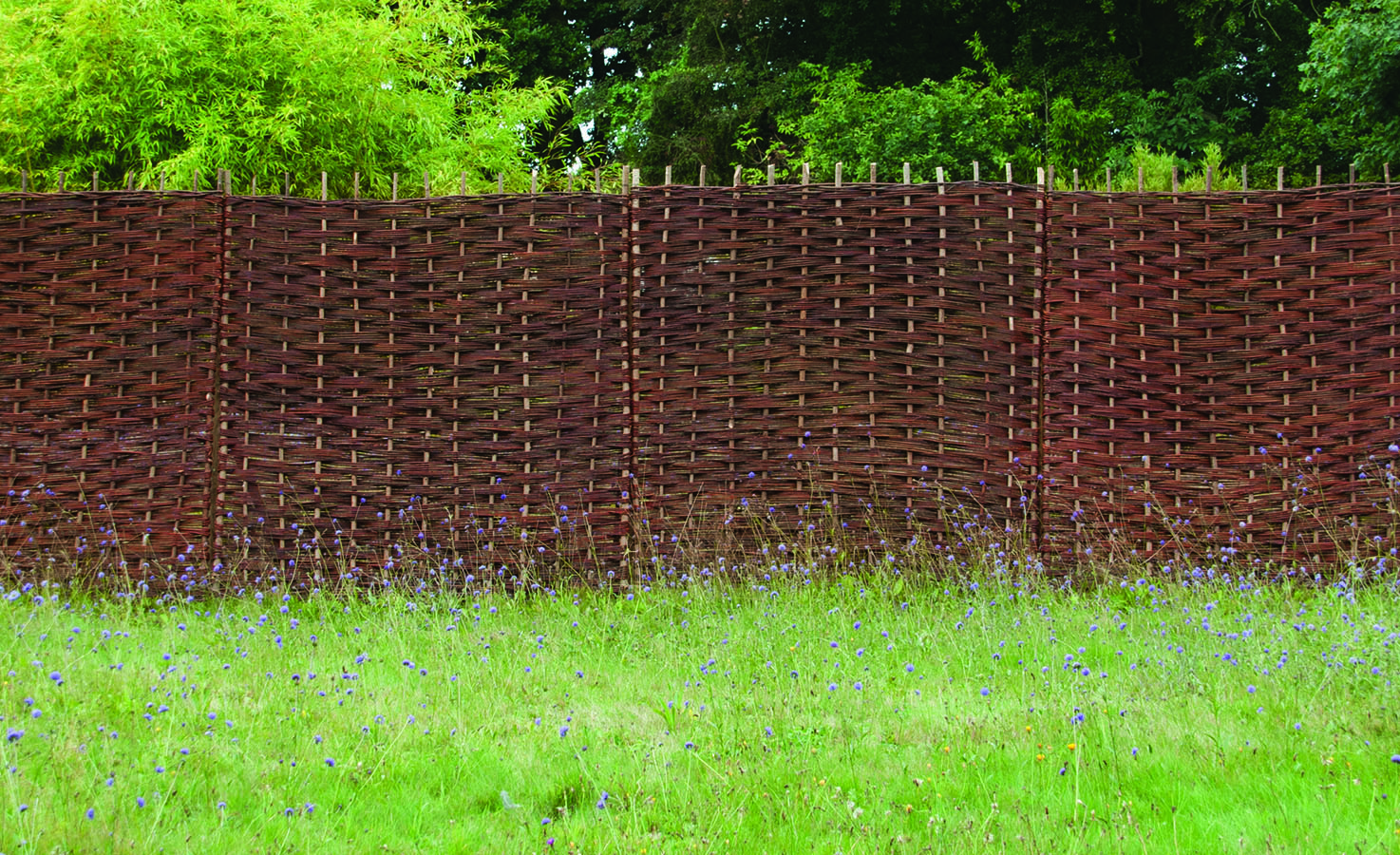
A hurdle has no good side. Both faces are woven identically, because the panel is made by weaving rods around uprights rather than nailing boards to a frame. There is no smooth side and no framework side. Whichever way you hang it, both of you get the same fence.
It is a small thing that removes an entire category of argument, and it is one of the reasons hurdles suit shared boundaries so well.
The same goes for repairs. There is no framework to rot out of sight on one side, and if a rod breaks it is visible and identical from both gardens.
What about height and light?
A 2m fence is permitted, but “permitted” is not the same as “sensible”. A full-height solid boundary on the south side of a small garden will take real light off a border, and that is worth thinking about before you build to the maximum simply because you can.
This is where a woven panel behaves differently from a solid one. A hurdle is porous — it filters light and air through the weave rather than blocking both outright. You still get privacy from a few feet back, but the shade behind it is softer and planting close to it does better. Hurdle fencing goes into why that matters for wind as well.
There is also the high hedges legislation, which lets a council intervene over an evergreen hedge above 2m. It applies to hedges, not fences — but worth knowing if your plan is a fence now and a hedge behind it later.
Common questions
Is it legal to have a 7ft fence in the UK?
Not without planning permission, in almost all cases. The permitted limit in England and Wales is 2 metres, which is about 6ft 7in, and drops to 1 metre where the boundary adjoins a road used by vehicles. A 7ft fence exceeds it, and so does a 6ft fence with a foot of trellis on top.
Can I legally paint my side of my neighbour’s fence?
Not without their agreement. Even the face you look at is their property, and painting or treating it is an alteration. Most neighbours will say yes if asked. If you would rather not ask, you can put your own fence up just inside your boundary instead.
Worth adding: our hurdles are meant to be left untreated anyway. Stains and preservatives sit on the surface and trap moisture in the weave, so the question rarely arises.
Do I have to give my neighbour the good side of the fence?
No, there is no legal requirement. It is a widely followed convention rather than a rule. With a woven hurdle the question disappears entirely, because both faces are the same.
Which fence is mine, the left or the right?
Neither, as a rule. The left-hand-fence idea is a myth. Check your title deeds for T marks on the boundary plan: the crossbar sits on the side of whoever is responsible. If there are no marks, ownership may simply never have been established.
Do I need permission to replace an existing fence?
Not if it is yours and you stay within the height limits. If it is your neighbour’s fence, you cannot replace it without their agreement, even if it is falling down. You can put your own up alongside it.
Does the fence height include the posts?
Yes. Anything above ground counts, including posts standing proud and any trellis or topper. Cut posts level with the panel if you are near the limit.
Where hurdles sit in all this
Everything we make is 6ft or under, so it is inside the permitted height for a rear or side boundary without any application. Both faces are identical, so the good-side question never comes up. And because the weave lets light and air through, a full-height run is less oppressive than the same height in solid timber.
Browse hazel fence panels or willow fence panels in all six heights from 1ft to 6ft, see what a full run costs, or work backwards from the problem with our garden screening guide.
This is a plain-English summary of the general position in England and Wales, not legal advice. Deeds, covenants, conservation areas and local policy all vary, and your council’s planning department can confirm your own situation.